Commissioner Interview: Chanel Compton Johnson
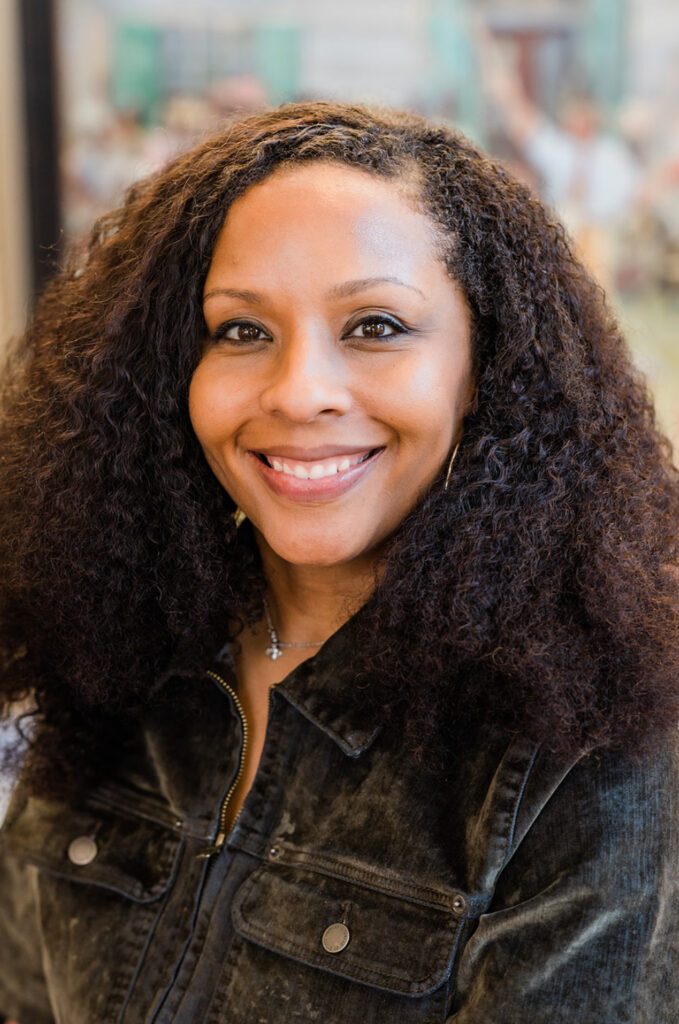
This month, we spoke with Chanel Compton Johnson, a practicing visual artist, the Executive Director of the Maryland Commission on African American History and Culture and the Banneker-Douglass-Tubman Museum, and Board Chair at Maryland Humanities. Born and raised in Bridgeport, Connecticut, Compton Johnson received her Bachelor’s degree from the Rutgers Mason Gross School of the Arts, and later graduated with her Master’s in Arts Management from American University. Since she was a child, art and creativity have been major influences in Compton Johnson’s career choice, as she always wanted to be an artist. However, her professional background is rooted in museum education.
In Compton Johnson’s early career, she worked on educational programming for cultural organizations such as Baltimore’s Creative Alliance, the African American Museum in Prince George’s County, and the Smithsonian African Art Museum. Knowing that creating art would be a constant regardless of her professional position, Compton Johnson looked for ways to incorporate her creativity into her community work as well. Her initial attempt at blending these interests resulted in the pursuit of a curatorial internship at the Studio Museum in Harlem, where she learned curation was simply not for her. Through this discovery, she began to shift her focus to museum education, a field she naturally gravitated toward. “I feel like it incorporated all the things that made my heart sing,” she shared. For Compton Johnson, working in a field where community, collaboration, history, and the arts intersect was the sweet spot.
Compton Johnson’s love for service began when she was just in high school. Growing up in Bridgeport, a largely Black and Latinx city, Compton Johnson often noticed how underresourced her school was, especially in relation to another local public high school in a neighboring town that was majority white. She recalled participating in a cultural exchange program with this school, and she witnessed firsthand the disparity in accommodations between her school and the school in the white neighborhood. This experience prompted the revelation for Compton Johnson that, not only did her school deserve better, black people and people of color deserved better in general. From that point, Compton Johnson began to have more conversations with her teachers and peers about these issues, and her frustration with the status quo bloomed into a desire to do whatever she could to help the people of her community feel seen. Even in her work as an artist, Compton Johnson explicitly makes a point to educate the public about different aspects of black history, culture, and identity. “I know I won’t change the world, but I can change a little bit, whether through volunteerism or community arts work.” Compton Johnson believes that her work in the youth programming space has been especially fulfilling due to her own experiences, describing it as a healing cycle. “I want to be what my peers deserved, ” she told us. The programming Compton Johnson helped develop at the African Art Museum and Baltimore Creative Alliance is at no cost to students. “Even though their parents can’t afford to send them on a private school experience, they still deserve that level of excellence and experiential learning.”
When asked what she would like Marylanders to know about the Maryland Commission on African American History and Culture, Compton Johnson told us that MCAAHC is a multi-tiered agency, which operates the Banneker-Douglas-Tubman Museum, and co-administers the African American Heritage Preservation Grant in partnership with the Maryland Historical Trust. Through this grant program, the MCAAHC awards up to $5 million to African American heritage sites across the state each year. Additionally, the Commission provides statewide technical assistance, advocacy, and legislative support to African-American heritage projects. Combatting the erasure of Black history is a charge that Compton Johnson and the rest of the commission take very seriously. “Our job as a Commission is to ensure that living heritage sites are thriving, accessible, resourced, and celebrated.”
When she thinks of America, Compton Johnson thinks of the men and women who came before her and took on the fight for freedom and democracy, all while carrying on with their daily lives. Compton Johnson recalled surmising with a colleague in an earlier conversation about what that must have been like. “They still had to get up in the morning, take their kids to school, go to work, and do grocery shopping. They still had to live their lives, and their survival was also resistance.”
For the 250th, Compton Johnson hopes that stories that weren’t centered during the bicentennial are included in the semiquincentennial commemoration. “It’s poetic that the 250th is happening in the same time we’re living in now, where black history, art, culture, diversity, and inclusion are consistently and overtly under attack.” She believes that the semiquincentennial provides an opportunity to reflect not only on history, but on what we want the next fifty years to look like as well. “This country was built on people saying ‘hell no’ to tyranny and authoritarianism.”
For Marylanders who may feel helpless in the moment, Compton Johnson encourages them to simply do what they can. She tells us, “Whatever small change you can make is a blessing.” From her early foray in advocacy to her arts education and youth programming, Compton Johnson’s work exemplifies this very philosophy. Compton Johnson’s passion for her work can be felt in all that she does, and we are grateful to have commissioners such as herself helping to mold the semiquincentennial experience here in Maryland.