Commissioner Interview: Pete Lesher
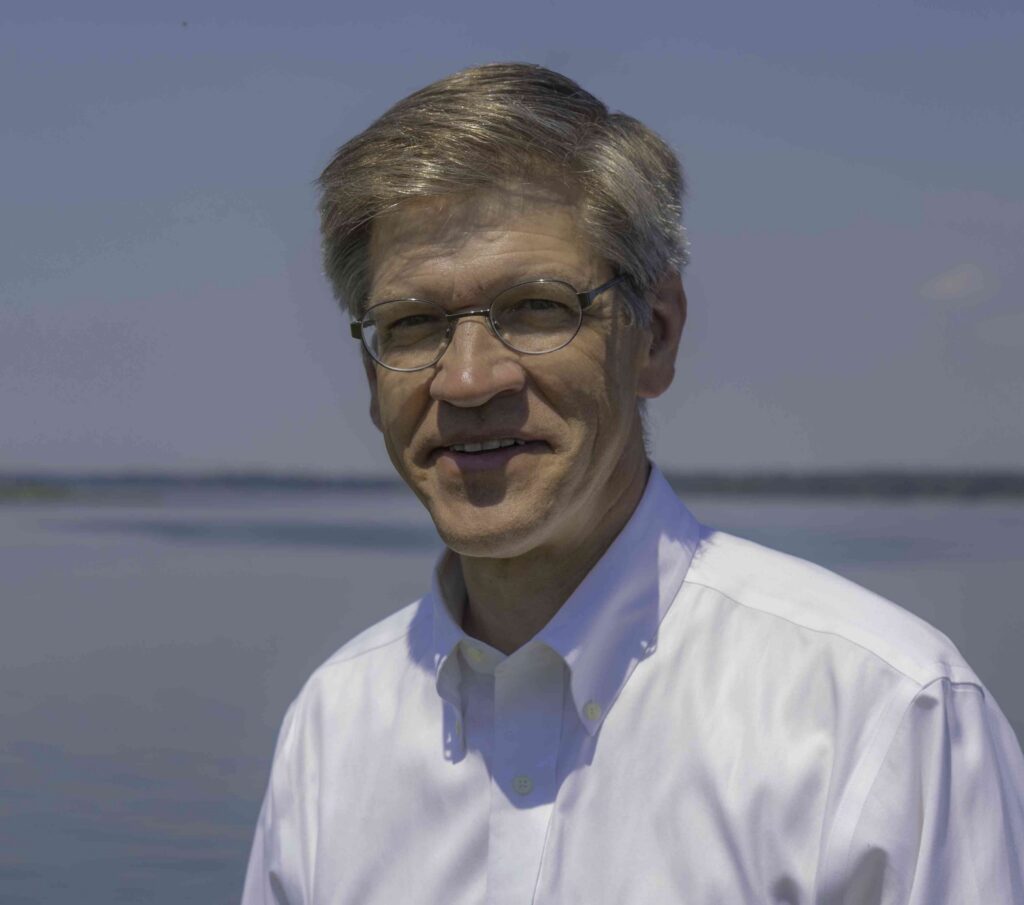
For this month’s newsletter, we had the pleasure of speaking with Pete Lesher, Chief Historian of the Chesapeake Bay Maritime Museum, Vice President of the Talbot County Council, and MACo representative on the MD Two Fifty Commission.
Lesher’s career path was greatly influenced by his childhood experiences. His parents immersed him and his four younger siblings in history and nature. They often visited and camped in national parks. Lesher recalls camping outside of Boston, visiting historic sites along the Freedom Trail, and experiencing the USS Constitution for the bicentennial. Having grown up near Philadelphia, Pete also has fond memories of visiting places like Independence Hall, and hearing the stories attached to them. “I learned about these stories in the spaces where the events occurred,” he shared. Through his eyes, some of the most inspiring people he encountered on these adventures were the park rangers and interpreters who conveyed the stories of these spaces. By the time he reached high school, Lesher was sure he’d be pursuing a history major in college. Immediately after his undergraduate studies, Lesher went on to continue his history education in grad school. Though he never imagined himself working in museums for his career, he got a museum internship during graduate school, and has been with the Chesapeake Bay Maritime Museum ever since.
When it comes to his path to public service, Lesher describes the role as something he felt called to do. Even in junior high, he often participated in public debates. He was greatly inspired by his civics teacher, a member of the local Republican Central Committee. “She would read us opinion columns by Mike Royko of the Chicago Tribune, and encouraged us to talk about the issues of the day, both locally and nationally.”
Pete Lesher has been on staff at the Chesapeake Bay Maritime Museum for 35 years. Throughout his time there, his role has shifted a time or two. While he started with the Museum as an intern, over the course of the years he has been an assistant curator, a curator, curator of collections, chief curator, and now chief historian. “My job as a public historian is to get past the extraneous details, construct the engaging story, and connect it with what is happening today.” Lesher’s mission as the chief historian of the Chesapeake Bay Maritime Museum is to figure out how different stories might resonate with the lives of his audience, and help them understand how events in history can still affect them. “People have a right to ask why things are important, and as historians we have a duty to answer them.”
Lesher’s initial foray into the public service realm manifested itself as an opportunity to serve on the St. Michael’s Historic District Commission, after he’d begun working at the Maritime Museum. He was recruited by St. Michael’s new town manager at the time. “I thought, ‘What do I know?’ and he talked me into it.” Lesher served on the commission on and off, but eventually chaired for twenty years. After his move to Easton, Lesher got on a second Historic District Commission while staying on in St. Michael’s. After a few years of serving on Easton’s commission, the chairman encouraged Lesher to run for town council. He ran, won in a three-way race, and was reelected twice. He recalls being in the middle of his third term, attending a Fourth of July event in St. Michael’s where he gave the public address, when a friend began the process of talking him into running for county council. “It felt like a reasonable next step for me,” he told us. Now, even as a member and vice chair of the county council, Lesher is often asked about whether or not he’d run for other offices. “Local government is where my heart is,” he tells us.
When asked what he’d like Marylanders to know about MACo and Talbot County, Lesher told us that MACo is a “wonderful place, where people from different parts of the political spectrum find common ground, and speak with a common voice.” MACo, the Maryland Association of Counties is constituted of elected officials and staff from Maryland’s twenty-three counties and Baltimore City. Lesher appreciates the existence of a space where counties can come together to resolve issues within local government. “Local issues are not always defined by party affiliation,” he shares, “There really isn’t a Republican or Democratic way of doing things like land use planning, and so I find alliances and can get things done because I can work with people who do not share my political philosophy.” Lesher referenced the quote from Lincoln’s first inaugural address, “We are not enemies, but friends. We must not be enemies.”
When it comes to the Chesapeake Bay Maritime Museum, Lesher shared how much the Museum has evolved in its public history mission, committing more to “making lessons of our local and regional history relevant.” Additionally, he wants Marylanders to know that the Museum is one of the top tourism destinations in the state of Maryland. The Museum was created to be a heritage tourism destination to support the region in the midst of a faltering seafood industry. Over time, the museum realized that in order to make a greater impact and attract more visitors, they would have to find ways to serve and involve the community, as well as the tourists. “We’ve created this dual profile of both a heritage tourism destination, and a community museum of service.”
Lesher defines the United States as a nation built on ideas, rather than an ethnicity, and emphasized that citizenship is an intentional choice.“ In America, it is anyone who subscribes to this idea, whether they are born here or not.” He shared with us that his family provided housing and other support to a family of Vietnamese refugees in 1975. He recalls sharing his room with the youngest brother, and watching his parents learn to be ESL teachers. Lesher’s family worked vigorously to help reunite them with their loved ones, and after about a year and some careful planning, assisted their guests with the process of buying a house. “We worked with our congressman at the time to help locate all these people, and bring them back together.” Years later, Lesher and his family learned that the eldest brother named his daughter Annabel, which is not a family name, but the name of Lesher’s own mother.
Lesher’s hope for the MD Two Fifty Commission and the 250th in Maryland is that “the stories we capture, the public engagement we foster, and the renewal of dedication to civic services becomes the enduring legacy of the Maryland 250 Commission.” Lesher reflected on his experiences during the bicentennial celebrations, and how invested people were in exploring historic sites like Williamsburg, Plymouth Plantation, and Philadelphia. “There were projects that I think brought us together, and helped us reexamine the American story.” This reexamination is something Lesher hopes we continue to do for years past the 250th.
For Marylanders that may feel disillusioned in the current times, Lesher encourages them to find what connects us, rather than what sets us apart. “What are those American values? What is it about this American idea that we can all agree on?” For Lesher, looking for spaces where we can find our niche and come together as a community is the most important thing one can do at this time. Individuals such as Pete Lesher are truly important to have leading in our state. His lifetime of curiosity about the past has led him to serve in a way that helps synthesize that past in order to better navigate the future. We are grateful to have commissioners such as himself, whose care for his community shows in all that he does.