Commissioner Interview: Sandi Olek
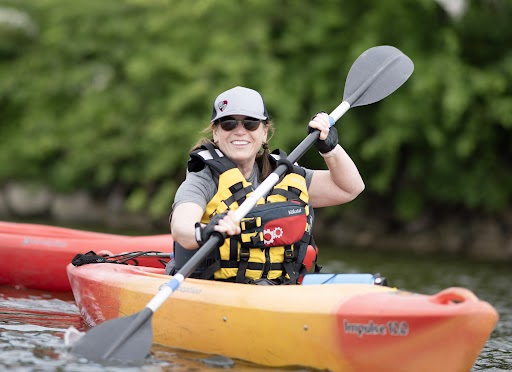
This month, we sat down with MD Two Fifty Commissioner Sandi Olek, Director of the Office of Outdoor Recreation for the Maryland Department of Natural Resources. Olek has served in this position since 2023. Prior to this role, she served as the Associate Director for the Maryland Forest Service as well as the Director of Environmental Conservation Education.
Sandi Olek’s story begins in Prince George’s County. She was born and raised in Prince George’s County, with family roots in both Washington D.C and Baltimore,Maryland. She grew up on land connected to the WSSC, and in her childhood, spent much of her time roaming the forests and streams in her own backyard. Olek’s mother grew up in Rock Creek Park, resulting in Olek and her siblings becoming quite acquainted with the land their mother had enjoyed before them. Olek is the youngest of four, so when her mother needed a means of entertaining her children, going back to her own roots was an obvious choice. “In my childhood, I spent a lot of time at the Nature Center at Rock Creek Park and in the surrounding woods and streams.” She expressed deep gratitude to her mother for giving her those early experiences, and noted that this exposure, in conjunction with her love for science greatly influenced her career trajectory. According to Olek, these two spaces were what inspired her to pursue environmental work.
In addition to her childhood experiences, Sandi Olek’s community also played a major role in her career path. From a young age, Olek was surrounded by people who worked in the science and civics service fields. Olek’s father was an attorney with the U.S. Department of the Interior, and her friends’ parents were rocket scientists for NASA. Even her in-laws were intelligence officers for the NSA. “Having that love for nature, and being inspired by such bright and dedicated people around me made science and service such a natural connection for me.”
As a born and raised Marylander with an affinity for nature, Olek recognizes the strong identity of the Chesapeake Bay and waterways that many Marylanders have, and believes her attraction to water and its calming nature have helped guide her to where she is today. “I was fascinated by a world that you couldn’t see but you knew was there.”Olek shared that she attended Eleanor Roosevelt High School, a science and technology school in Prince George’s County. “It really buoyed my love for science.” While attending Eleanor Roosevelt provided the push for her to delve more into marine biology, she also became more curious about how decisions in communities are made and why, which led her to explore land use as a career pathway.
When the time came for her to transition into her undergraduate studies, Olek pursued marine biology at the University of Maryland, where she was exposed to many parts of the discipline such as chemistry, forest ecology and biology. This led her to work for the Chesapeake Bay Program, which is the national estuary program with the EPA and other signatory partners, where she got a firsthand look at how the Chesapeake states collaborated on policies pertaining to land use, water quality, and living resources. This allowed her to have “a better understanding of all the decisions that go into restoring the bay and nearby waterways.”
Olek shared that she is also in a former military family, and while her husband was stationed in Norfolk, Virginia in the US Navy she was able to pursue her graduate studies at Old Dominion University with a Masters degree in Marine Ecology. There, she studied phytoplankton of the Chesapeake Bay. Olek explained that phytoplankton is the base of the ecological food chain, and that their populations essentially determine the health of all other food chains, water quality and life in the Bay. “It sounds obscure, but it’s not – it really impacts water quality and more. When we talk about dead zones, phytoplankton is a huge part of that.” She told us that “getting to come from policy and working with other states, to then having the opportunity to spend time on the rivers and Bay doing water quality research, and digging into the science was such a great trajectory for me.”
Following her graduate studies, Olek worked as a local land use planner in the Tidewater area of Virginia, where she was able to further apply her knowledge of how land use impacts our waterways, as well as how to engage communities in the process. According to Olek, Tidewater at that time had the fastest rates of wetland conversion in the country. Eventually, Olek and her husband decided to move back to Maryland, and she went to work for the DNR on the heels of Former Governor Parris Glendening’s (MD Two Fifty Chair) Smart Growth Package. “It was such an exciting time to be able to employ creative policy solutions that were not top down but bottom up.” In this new role with the Department of Natural Resources, Olek learned a lot about state government, state and local partners, as well as state budgets and legislation. Throughout her time at DNR, she has worked in various areas including but not limited to climate adaptation, climate resiliency, land use, and the science of the bay. Olek has also championed programming around community planning, and environmental education, working through projects such as the Maryland Park Equity Analysis to help provide more Marylanders with access to nature. “Through my work on environmental education, access to nature, the impacts of nature and climate on health, and a short stint with the Maryland Forest Service, I was able to wrap it all together when I was asked to serve as the Director of the Office of Outdoor Recreation for the State.” Olek shared that Maryland’s outdoor spaces not only help to bring its communities together, but they are also a large part of what attracts visitors to our state, so ensuring that these spaces can also be enjoyed by everyone is a top priority. “Our goal at the office of Outdoor Rec is to make our spaces and places more welcoming.”
Outside of her professional life, Olek’s community service work has included serving on the Howard County Environmental Sustainability Board, and leading after school nature clubs when her children were in school. These days, Olek enjoys taking time to visit DNR partners on the weekends. These visits can range from joining a mountain bike club at their races and participating in trail cleanups to birding and attending nature walks. “I give a lot of my time on the weekends to really get a feel for who our partners are and what projects they have going on.”
When asked what she would like Marylanders to know about the DNR and the Maryland Parks Service, Sandi Olek shared that between Maryland’s forests, parks, and wildlife management areas, these organizations own and manage over 500,000 acres and 1,100 miles of trails. Additionally, they are the biggest owner of historic properties. “A lot of people don’t realize that Program OpenSpace is a percentage of the real estate transfer tax, and is used to support the acquisition and preservation of properties as well as recreational infrastructure at the local level.” According to Olek, Program OpenSpace is one of a number of programs managed by DNR where recreational user groups support the establishment and upkeep of infrastructure such as hunter and anglers contributing to habitat protection, Off Highway Vehicle users contributing to trails and boaters contributing to water access improvements DNR supports and manages these and more programs as they also oversee the science of managing fisheries and natural resources, set limits to the protection of rare, threatened and endangered species, and keep people safe on the waterways and lands via the Natural Resource Police. “We’re what you would call a super agency, but with some of the most passionate and dedicated civil servants you will ever meet. The enthusiasm and energy and how much we learn from one another has never ceased to amaze me.” Olek also shared that the DNR now has a park in every county, and they are currently working on a partnership park with Baltimore City in the Gwynns Falls. “From hikers and bikers to equestrians and anglers, so many people hold these spaces dear to their hearts.”
When asked about her thoughts on America, the 250th, and her hopes for the 250th celebrations here in Maryland, Olek shared with us that America to her is a diversity of people and landscapes, and a place where we all have a role. “From stories of immigration and family to opportunity and service, each of us brings a unique history to the collective.” She feels this is especially true in Maryland, as residents often jokingly call the state “America in miniature,” not only in reference to the people, but the natural landscape and its history as well. Olek’s hope for the MD Two Fifty Commission has been for it to share DNR’s commitment to a holistic representation of the state, which she feels the Commission has done exceptionally well. “I have felt from joining the Commission the same commitment to the holistic interpretation of the lands, spaces, communities, and people, and I am proud to see that and be part of it.”
For Marylanders who may feel powerless or disillusioned, Olek suggests leaning into volunteer opportunities, highlighting the Maryland Park Service as a possible outlet. “What you do in your backyard ripples way beyond that.” From planting native plants to doing neighborhood cleanups, Olek wants Marylanders to know that small actions they take can make a major impact.
Before closing, Olek emphasized that the Office of Outdoor Recreation supports not only Maryland tourism, but it also works to connect people to the outdoors, and encourage residents to see themselves as stewards of the land. She also wants Marylanders to know that the Outdoor Recreation industry is built on small businesses. “It’s the small businesses that are the boat dealers, outfitters, and bike repair shops. It’s this network of small businesses that we value so much.” For Olek, we shouldn’t just think of outdoor recreation as simply products of our government, but as spaces for us to embrace as our own.
It does not take long to gather that Sandi Olek truly enjoys what she does. Like many of our Commissioners, Olek leads with passion and dedication when speaking about the many ways she gets to serve the people of our state. We are grateful to have her representing the DNR on the Commission, and appreciative of the unique perspective she has shared with us.