Commissioner Interview: Terri Freeman
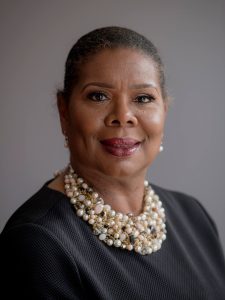
This month, we had the pleasure of speaking with Terri Freeman, President of the Reginald F. Lewis Museum. Freeman was born and raised in Chicago, Illinois as an only child. She was raised mostly by her mother and grandparents, as her parents divorced early on in her childhood. More so than anyone else involved in her youth, Freeman credits her grandfather with having the most significant impact on her career. A self-trained artist, Freeman’s grandfather was syndicated in black newspapers for a portrait series he developed called “Interesting People”, where he illustrated interesting African Americans. His syndications eventually became books he published, highlighting prominent African Americans in global affairs and athletics. Freeman shared that her grandfather’s artwork began in the 1920’s; his primary subject matter being sports, but he focused most on boxing. He would submit his artwork to the Chicago American, until the newspaper learned that he was black. After that point, the Chicago American no longer accepted his artwork. Consequently, Freeman’s grandfather discontinued his publicity work for the newspaper to make his career at the Chicago Post Office. However, he continued to draw. “My grandfather told me that when Joe Lewis made his first fifty dollars on a fight he won, he made his first fifty on the publicity he did for the fight.” Little did she know, her grandfather’s stories would have much greater influence in the direction of her career than she anticipated.
Freeman never imagined she would work directly in the realm of African-American history. She attended the University of Dayton, studying journalism and communication arts. Immediately after completing her undergraduate schooling, Freeman attended graduate school at Howard University to study organizational communications management. Her early roles connected more directly to her studies, as she was initially hired by Freddie Mac as an editorial assistant. Freeman progressed through the organization, eventually leading the internal communications and sales training functions for the corporation, and later becoming the Executive Director of the Freddie Mac Foundation, which she helped create. Under Freeman’s leadership as the founding Executive Director, the organization awarded around $200,000 in grant funding within their first year, and a total of $8 million by the time of her departure in 1996. From the Freddie Mac Foundation, Freeman went on to the Greater Washington Community Foundation, where she served as President for eighteen years. When she left in 2014, the organization had nearly $400 million in assets.
Freeman’s next role as the President of the National Civil Rights Museum at the Lorraine Motel in Memphis, Tennessee was her introduction to the museum field. Not only was her time in Memphis fruitful, she had the opportunity to meet many of our nation’s Civil Rights icons, such as James Lawson, John Lewis, Jesse Jackson, and Bernice King. During her time at the Civil Rights Museum, Freeman led the planning for the 50th anniversary of Martin Luther King Jr.’s assassination, which was an international celebration, where bells around the globe rang thirty-nine times at the time of King’s death to signify the thirty-nine years of his life. “It was a very moving, incredible experience,” she shared.
After a serious car accident, Freeman returned to Maryland in 2020, rejoining her husband after the two had been commuting to see one another once a week during her time in Memphis. Upon her move back to Maryland, Freeman secured her position as the President of the Reginald F. Lewis Museum. “ After almost twelve years in the field, I can no longer say I am not a museum person.”
Over the course of Freeman’s career, service has always been at the forefront. In each of her roles, it’s been important to Freeman that both her employees and constituents have what they need to succeed. “My career has really focused on how I can impart adequate information and resources to the community, so they can do the work they need to do.” She recalled the outstanding people she met during her time in the philanthropy field, “who truly are selfless in what they want to accomplish, and how they want to help the community.” In the museum field, service for Freeman has been centered around highlighting important stories that teach us about the past, and help us navigate the future. “I realize that history is not all that exciting to a lot of people, but if we take a look at what has happened, you can see the seeds of why we are where we are today.”
When it comes to The Lewis, Freeman would like Marylanders to know that it is a museum for everyone. She stresses that while The Lewis tells a story of American history through the lens of African Americans in Maryland, the history is for everyone to know. “It is quite likely that the history represented in the museum has, in some way, impacted everyone who lives in the state of Maryland, regardless of race, creed, or color,” she shared. Freeman also wants Marylanders to know that The Lewis is “a living, breathing organism,” representing history through programming, film screenings, art, panel conversations, and music, in addition to its exhibits. The Lewis’ supplementary experiences exist to augment and bring to life the artifacts and information that live there.
For Freeman, America has meant many things. It has meant hope and opportunity, as well as complexity and the acknowledgment of disturbing truths. While Freeman still considers herself to be a proud American, she admits there are parts of our country’s history that give her pause. She referenced the Founding Fathers’ conflict around providing freedom for every human in the country yet endorsing slavery, and how these parts of our history expose our flaws as human beings. For these reasons, Freeman places considerable emphasis on the necessity to reflect on our past to help guide our future.
As the 250th has approached, Freeman’s excitement for this commemorative year has grown. She’s had the opportunity to be a reviewer for the Pew Charitable Trust arts grants, many of which are centered around the semiquincentennial. Through this experience, Freeman has gotten a glimpse of some of the programming happening in Philadelphia, in addition to what she has seen in Maryland. Freeman’s hope is that through the various events and experiences planned for this year, people will take the opportunity to learn more about the nation’s founding, as well as the many different groups that call it home. She recalls the celebrations around the bicentennial, and feeling as though there was not much education to accompany the celebratory activities. Freeman wants differently for the 250th in Maryland, and recognizes that it is incumbent upon the Commission to promote events that will enrich Marylanders’ knowledge of our state.
When asked about how Marylanders who might feel powerless or disillusioned can make a difference in their communities, Freeman pointed to civic engagement. “The country is what we make it. America is not just the land and the boundaries, but the people who live here.” For Freeman, civic responsibilities in all their forms should be taken seriously. She also believes that we should invest more time into understanding the power we have as citizens. “People may feel they’re helpless, but that’s really not true.”
Terri Freeman’s journey – from listening to her grandfather’s stories about his role in history, to playing a key role in keeping others’ stories alive – is one fueled by a love for service and community. Her journey is a testament to the power of using personal gifts and opportunities—whether in philanthropy, communications, or history—to build and strengthen the community, ensuring that all voices and histories are heard and valued. Our commissioners are truly one-of-a-kind, and we are grateful to have them.